
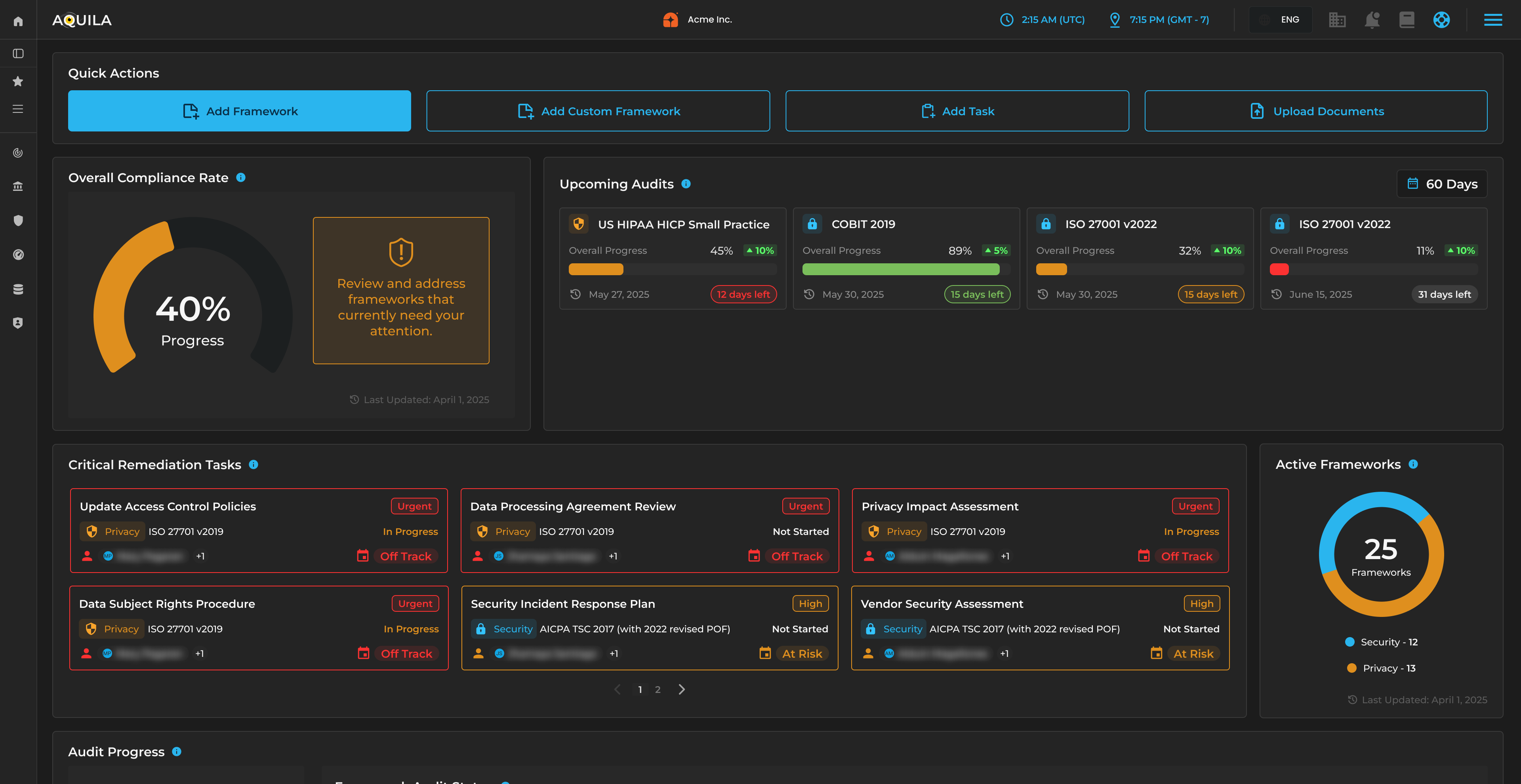
AQUILA Endpoint Agent integrates a Compliance Agent that enforces governance policies at the device layer, drives user participation in compliance workflows, and synchronizes evidence and control validation with AQUILA C4I’s Unified Controls Blueprint (UCB).


![[interface] image of a computer showcasing educational software (for a edtech)](https://cdn.prod.website-files.com/6954708495d04649d41c9ddd/69ae3a07bbb88a5f24718bcd_Compliance%204.jpeg)

Across global enterprises, compliance breaks down at the endpoint:
• Policies are documented but not enforced
• Evidence collection is manual and inconsistent
• Users ignore or delay compliance tasks
• Controls drift over time
• Auditors receive incomplete or outdated artifacts
• Compliance becomes a once‑a‑year scramble
Traditional compliance tools operate at the framework level, not the device level. They track requirements but do not enforce them. They document controls but do not validate them. They rely on users to remember tasks, deadlines, and obligations.
AQUILA Endpoint Agent corrects this by embedding compliance enforcement directly into the endpoint architecture, where governance, telemetry, and user behavior converge.

AQUILA’s Compliance Agent operates as a local governance engine, enabling:
• Real‑time enforcement of compliance controls
• Automated evidence collection
• User prompts, nudges, and reminders
• Contextual compliance guidance
• Validation of control execution
• Synchronization with UCB for unified governance
This transforms compliance from a documentation exercise into an operational capability embedded in every endpoint.

AQUILA Endpoint Agent applies the C4I pillars directly to compliance:
Command: Local enforcement of governance rules, control requirements, and compliance policies.
Control: Execution of compliance actions — configuration checks, evidence capture, remediation prompts — directly on the device.
Communications: Structured compliance telemetry streamed to AQUILA C4I Core OS and mapped to UCB.
Computers: Local evaluation of control state, configuration drift, and compliance posture — even offline.
Intelligence: Integration with UEBA, AI‑driven monitoring, and asset governance to detect compliance‑relevant anomalies and drift.
This alignment ensures that compliance is continuous, contextual, and operationally coherent across the endpoint fleet.

AQUILA Compliance Agent shares the same telemetry engine as EDR, VDR, DLP, UEBA, RBI, Local SOAR, AI‑driven monitoring, and Asset governance.
This allows compliance to be evaluated in the context of:
• Endpoint configuration
• Vulnerability exposure
• User behavior
• Data movement
• Process execution
• Identity signals
• Asset inventory
Traditional compliance tools cannot correlate governance with this level of endpoint intelligence.

AQUILA’s Compliance Agent includes user‑facing engagement modules that:
• Prompt users to complete compliance tasks
• Provide contextual reminders
• Guide them through required actions
• Explain policy requirements
• Nudge behavior toward compliance
• Reduce accidental violations
• Reinforce governance expectations
This transforms compliance from a passive requirement into an active, user‑driven workflow. Users become participants in compliance — not obstacles.

The Compliance Agent continuously monitors:
• Configuration baselines
• Required security settings
• Encryption status
• Patch levels
• Application versions
• Endpoint posture
• Data handling behavior
• Identity and access signals
When drift occurs, the agent can:
• Prompt the user
• Enforce corrective actions
• Capture evidence
• Escalate to SOC or IT
• Trigger automated remediation
• Synchronize updates with UCB
Compliance becomes self‑correcting, not reactive.

AQUILA Compliance Agent integrates directly with the Unified Controls Blueprint (UCB), enabling:
• Automatic mapping of endpoint evidence to controls
• Real‑time validation of control maturity
• Continuous compliance monitoring
• Unified reporting across frameworks
• Elimination of redundant evidence requests
• Consistent auditor‑ready documentation
This ensures that compliance is:
• Measurable
• Traceable
• Auditable
• Continuously updated
Compliance becomes a living system, not a static project.

When compliance violations occur, AQUILA can:
• Enforce corrective actions
• Block non‑compliant behavior
• Isolate the device if required
• Terminate risky processes
• Trigger guided remediation
• Escalate to governance workflows
These actions execute locally, ensuring immediate enforcement. Compliance becomes both a preventive and responsive capability.

With AQUILA Compliance Agent, organizations gain:
1. Continuous, endpoint‑native compliance enforcement
Controls are validated and enforced where risk actually exists.
2. Automated evidence collection and drift detection
Compliance becomes operational, not manual.
3. User engagement that drives behavioral alignment
Compliance becomes part of daily workflow.
4. Unified governance across frameworks
UCB ensures consistency and eliminates redundancy.
5. A single source of truth for compliance posture
All compliance intelligence flows into AQUILA C4I Core OS.