
AQUILA Endpoint Agent integrates an AI‑driven monitoring capability that analyzes endpoint activity, correlates signals across nine security functions, and detects subtle patterns of malicious behavior that rule‑based systems routinely miss.


![[interface] image of a computer showcasing educational software (for a edtech)](https://cdn.prod.website-files.com/6954708495d04649d41c9ddd/69ae31aada7bd2ed042febd2_AI%20Monitoring%201.jpeg)

Modern endpoints generate enormous volumes of telemetry such as process events, file operations, network connections, identity activity, data movement, configuration changes, vulnerability exposure, browser activity, and behavioral deviations.
Traditional detection tools struggle because:
• Rule‑based systems miss long‑tail anomalies
• SIEM correlation lacks endpoint context
• EDR engines detect symptoms, not patterns
• DLP sees data movement, not intent
• VDR sees exposure, not exploitation
• SOC teams drown in alert fatigue
AQUILA Endpoint Agent corrects this by embedding AI‑driven monitoring directly into the endpoint architecture, where telemetry, behavior, and identity signals converge.
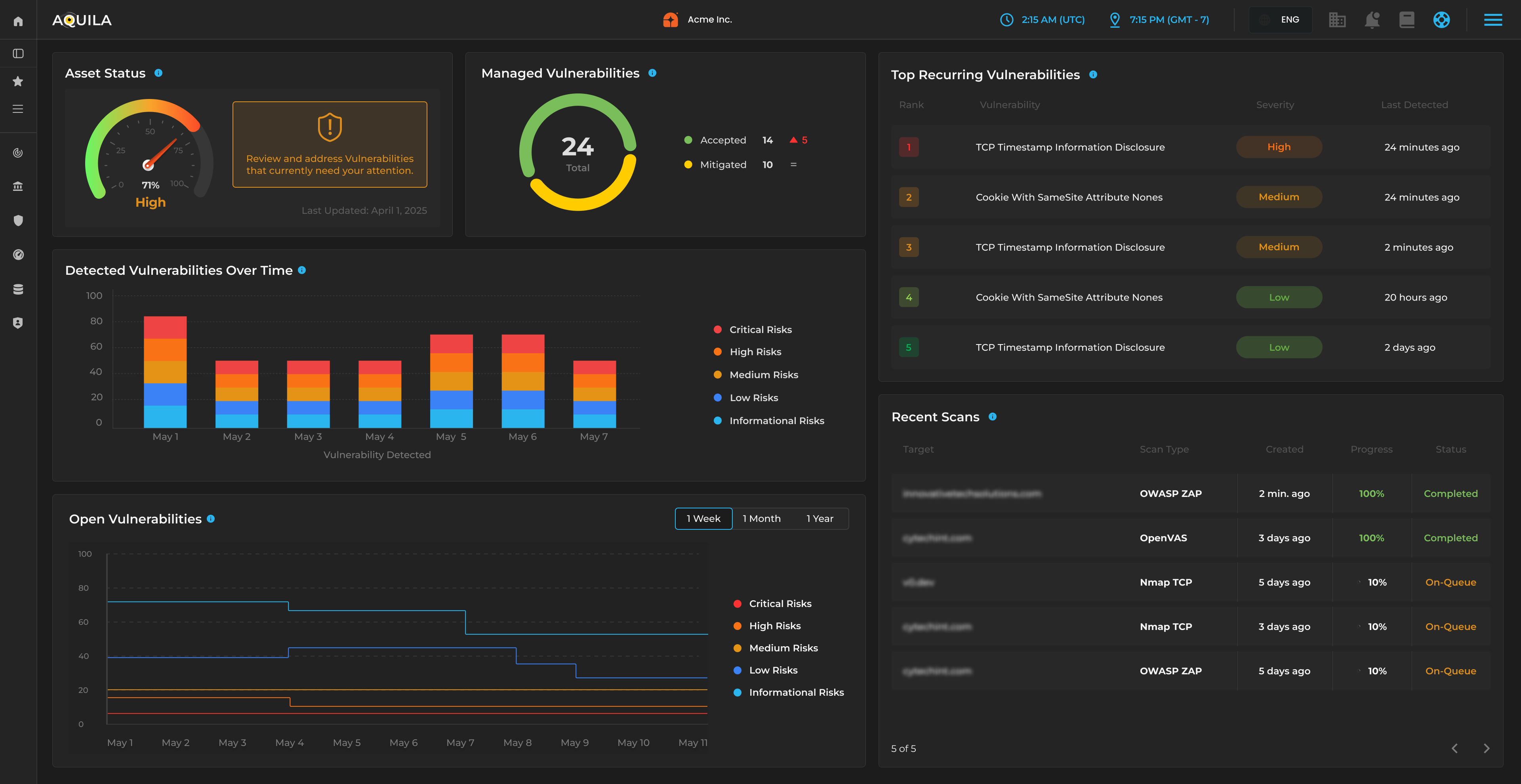
AQUILA’s AI‑driven monitoring module continuously analyzes process behavior sequences, privilege escalation patterns, anomalous file access, staged exfiltration indicators, dormant persistence mechanisms, slow‑moving lateral movement, identity misuse signals, deviations from UEBA baselines, and configuration drift and exposure chains.
Machine learning models detect:
• Subtle privilege escalation
• Staged attacks spread over long time windows
• Low‑and‑slow exfiltration
• Dormant malware waiting for triggers
• Anomalous parent‑child process chains
• Identity compromise patterns
• Insider threat indicators
Because AI operates locally, detection is immediate, contextual, and resilient — even when offline.
AQUILA Endpoint Agent applies the C4I pillars directly to AI‑driven monitoring:
Command: Local enforcement of AI‑driven detection policies and governance rules.
Control: Immediate response actions triggered by AI‑detected anomalies — isolation, process termination, session invalidation, or policy enforcement.
Communications: Structured AI‑derived insights streamed to AQUILA C4I Core OS for enterprise‑wide correlation.
Computers: Local ML inference ensures AI continues to function even without network connectivity.
Intelligence: AI models enhance UEBA, EDR, VDR, and DLP by correlating signals across all nine endpoint functions.
This alignment ensures that AI‑driven monitoring is continuous, contextual, and operationally coherent across the endpoint fleet.
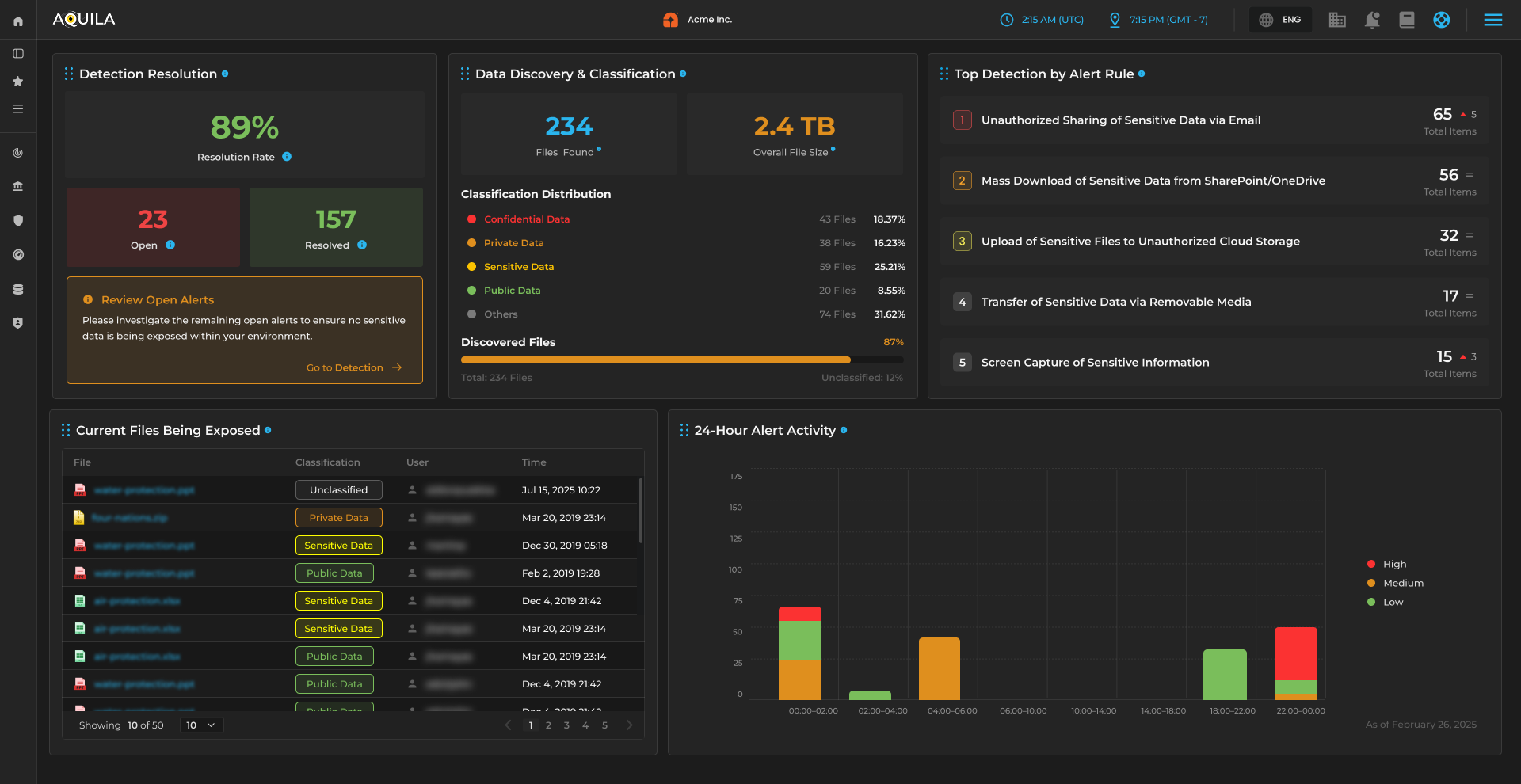
AQUILA AI‑driven monitoring shares the same telemetry engine as EDR, VDR, DLP, UEBA, RBI, Local SOAR, Compliance enforcement, and Asset governance.
This allows AI to correlate signals across:
• Identity behavior
• Process execution
• Data movement
• Vulnerability exposure
• Network activity
• Browser isolation events
• Configuration drift
• Endpoint posture
Other AI‑driven tools — typically cloud‑based and log‑dependent — cannot correlate signals with this level of endpoint intelligence.
AQUILA’s AI models detect:
Long‑Tail Behavioral Deviations
Patterns that unfold over hours, days, or weeks.
Slow Privilege Escalation
Incremental steps that evade rule‑based detection.
Dormant Persistence
Malware that hides until triggered by specific conditions.
Staged Exfiltration
Small, incremental data transfers designed to avoid detection.
Identity Misuse
Behavior inconsistent with the user’s baseline or role.
Lateral Movement Indicators
Subtle reconnaissance and credential probing.
High‑Risk Exposure Chains
Vulnerabilities combined with suspicious behavior.
AI becomes the correlation engine that ties together signals from all endpoint functions.
When AI detects a high‑risk anomaly, AQUILA can:
• Isolate the device
• Terminate malicious processes
• Block outbound connections
• Quarantine files
• Invalidate user sessions
• Trigger guided remediation
• Escalate to SOC workflows
These actions execute locally, ensuring immediate containment.AI becomes both a detection engine and a response trigger.
With AQUILA AI‑Driven Monitoring, organizations gain:
1. Machine‑learning‑driven detection at the endpoint
AI analyzes signals where attacks actually occur.
2. Early detection of subtle, long‑tail threats
AI identifies patterns that rule‑based systems miss.
3. Unified correlation across nine endpoint functions
AI evaluates signals in full operational context.
4. Reduced SOC fatigue
AI filters noise and highlights meaningful anomalies.
5. A single source of truth for AI‑derived insights
All intelligence flows into AQUILA C4I Core OS.