UCB is AQUILA C4I’s unified governance layer — a consolidated control architecture that maps global compliance frameworks into a single, coherent structure, enabling continuous validation, automated evidence collection, and real‑time compliance enforcement across the endpoint fleet.


![[interface] image of a computer showcasing educational software (for a edtech)](https://cdn.prod.website-files.com/6954708495d04649d41c9ddd/69af32a6cf1dcb680d3f1f4b_UCB%205.jpeg)

Enterprises operate under overlapping regulatory and industry frameworks: ISO 27001, SOC 2, NIST CSF, NIST 800‑53, CIS Controls, GDPR, HIPAA, PCI‑DSS, CCPA, State‑level privacy laws, and Sector‑specific mandates.
Each framework defines its own controls, terminology, and evidence requirements.
Most organizations respond by building:
• Parallel control sets
• Redundant evidence repositories
• Manual spreadsheets
• Inconsistent mappings
• Siloed governance workflows
This creates structural failures:
• Duplicated effort
• Inconsistent control maturity
• Audit fatigue
• Drift between policy and reality
• No real‑time visibility
• Compliance becomes reactive, not operational
UCB corrects this by unifying global frameworks into a single, normalized control architecture.
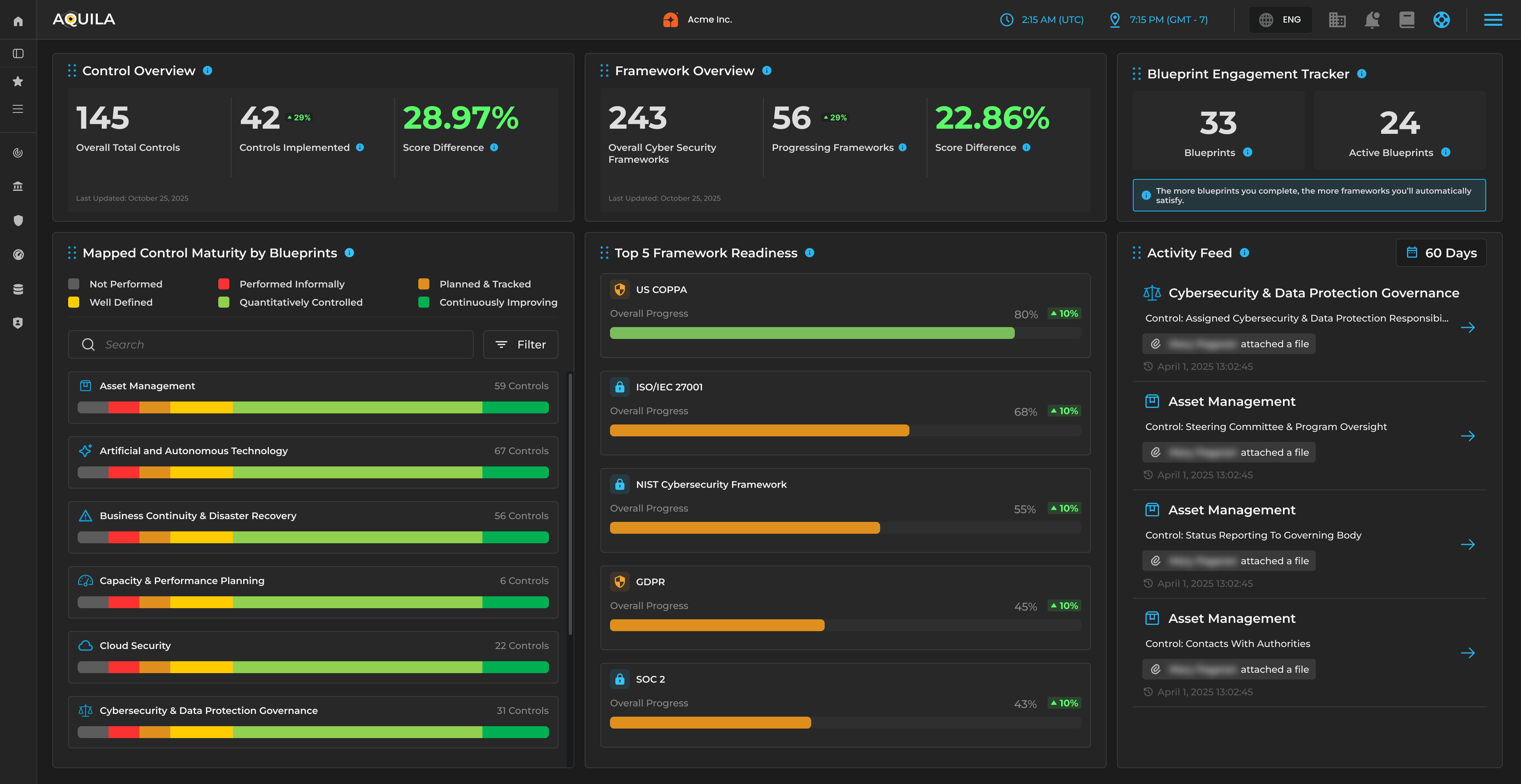
UCB consolidates hundreds of global controls into a single, coherent structure.
It provides:
• A unified control dictionary
• Standardized control definitions
• Mapped evidence requirements
• Cross‑framework relationships
• Inheritance logic
• Control‑to‑endpoint enforcement mapping
• Real‑time validation signals from AQUILA EPA
This eliminates redundancy and ensures that compliance is consistent, measurable, and operationally enforceable.
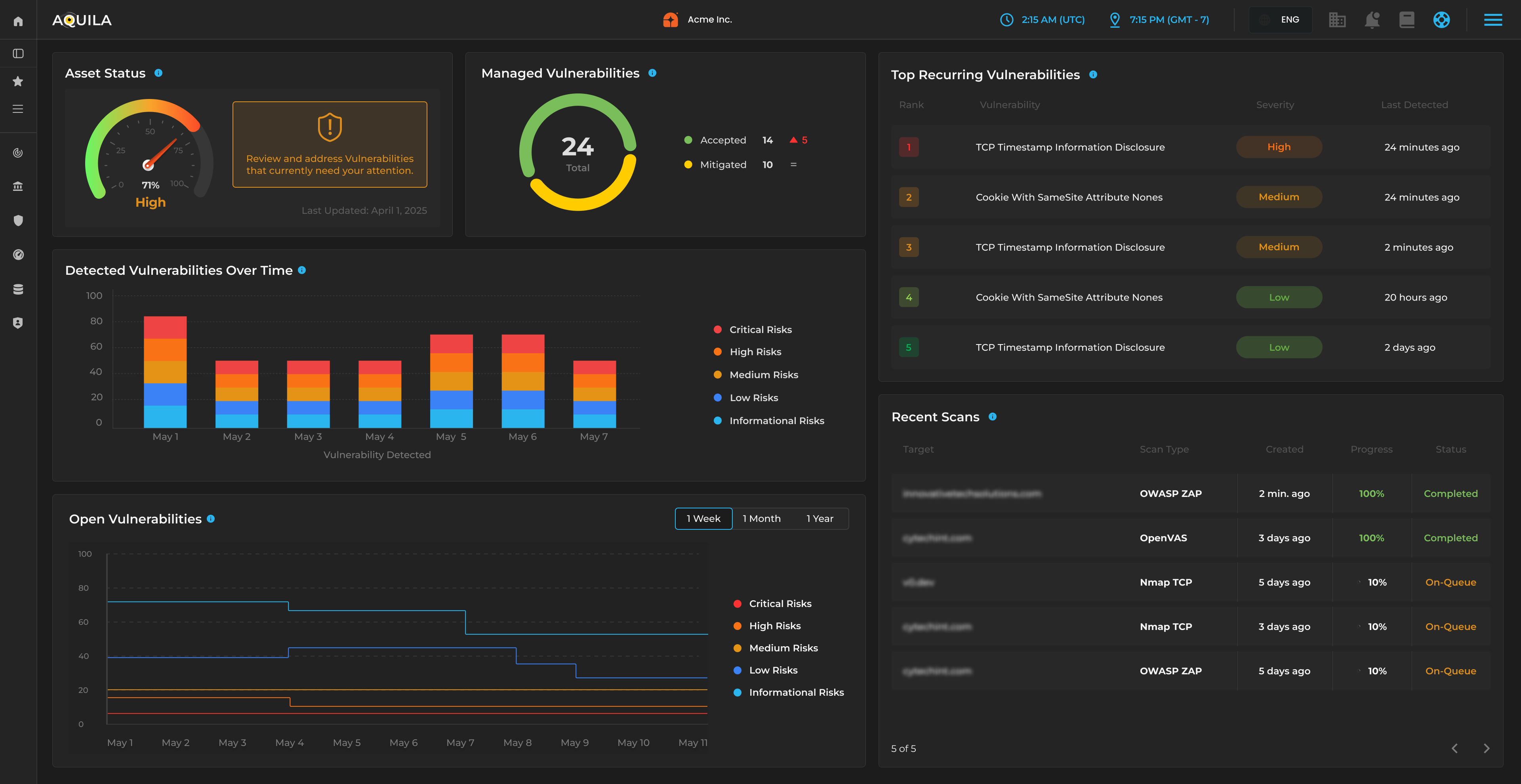
AQUILA applies the C4I pillars directly to compliance architecture:
Command: UCB defines the authoritative control set for the entire organization.
Control: UCB maps controls to enforcement mechanisms — including AQUILA EPA’s Compliance Agent, DLP, VDR, and configuration governance.
Communications: UCB synchronizes compliance state across governance, IT, SOC, and executive stakeholders.
Computers: UCB integrates with AQUILA C4I Core OS to evaluate control maturity using real‑time telemetry.
Intelligence: UCB correlates compliance drift, risk exposure, and behavioral anomalies to identify governance gaps.
This alignment ensures that compliance is operational, continuous, and command‑driven, not a static documentation exercise.
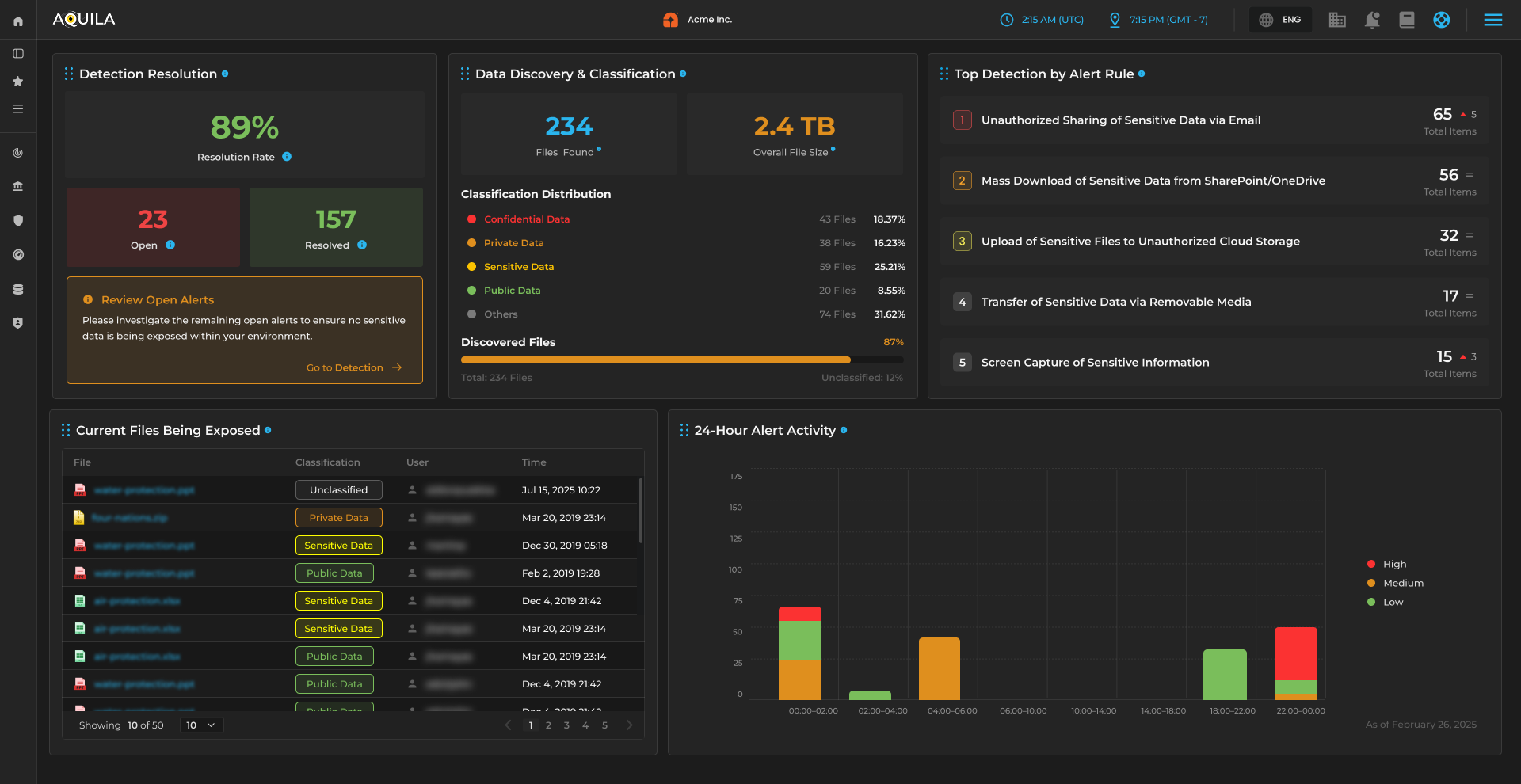
UCB receives structured compliance signals from:
• AQUILA Endpoint Agent (EPA)
• EDR
• VDR
• DLP
• UEBA
• RBI
• AI‑Driven Monitoring
• Compliance Agent
• Asset Management
• AQUILA C4I Core OS: identity governance, cloud configuration, data governance, human‑layer insights, policy enforcement state.
Because telemetry is normalized and contextualized at the source, UCB can evaluate control maturity in real time.
UCB maps global frameworks into a unified structure using:
• Control equivalence
• Control inheritance
• Cross‑framework relationships
• Evidence reuse
• Standardized terminology
• Normalized control objectives
This enables:
• One control → many frameworks
• One piece of evidence → multiple requirements
• One enforcement action → multiple compliance outcomes
Compliance becomes efficient, not duplicative.
UCB continuously validates controls using:
• Endpoint configuration state
• Vulnerability exposure
• Data handling behavior
• Identity activity
• Process execution
• User behavior baselines
• Cloud configuration
• Governance drift signals
This enables UCB to detect:
• Non‑compliant configurations
• Missing controls
• Outdated evidence
• Drift from baseline
• Unpatched vulnerabilities
• Unauthorized software
• Risky user behavior
• Policy violations
Compliance becomes continuous, not periodic.
UCB automates:
• Evidence collection
• Evidence mapping
• Evidence validation
• Evidence lifecycle management
• Auditor‑ready reporting
Evidence is:
• Collected at the endpoint
• Validated in real time
• Mapped to multiple frameworks
• Stored in a unified governance layer
• Synchronized with compliance workflows
This eliminates manual evidence collection and reduces audit fatigue.
UCB integrates directly with:
• Compliance Agent for control enforcement
• Asset Management for configuration validation
• VDR for vulnerability‑related controls
• DLP for data protection controls
• UEBA for identity‑related controls
• AI‑Driven Monitoring for anomaly‑based governance
• SOAR for automated remediation
This ensures that controls are not just documented — they are enforced and validated.
With UCB, organizations gain:
1. A unified control architecture across all frameworks
No more parallel control sets or redundant mappings.
2. Continuous, real‑time compliance validation
Controls are validated where risk actually exists — at the endpoint.
3. Automated evidence collection and drift detection
Compliance becomes operational, not manual.
4. Reduced audit fatigue and governance overhead
Evidence is mapped once and reused across frameworks.
5. A single source of truth for compliance posture
All governance intelligence flows into AQUILA C4I Core OS.