
AQUILA Endpoint Agent integrates a high‑fidelity EDR capability built on Elastic Security’s validated engine, enhanced with CyTech’s orchestration, governance, and C4I‑aligned endpoint architecture.


![[interface] image of a computer showcasing educational software (for a edtech)](https://cdn.prod.website-files.com/6954708495d04649d41c9ddd/69ada849480a7c58570ccefb_EDR%203.jpeg)
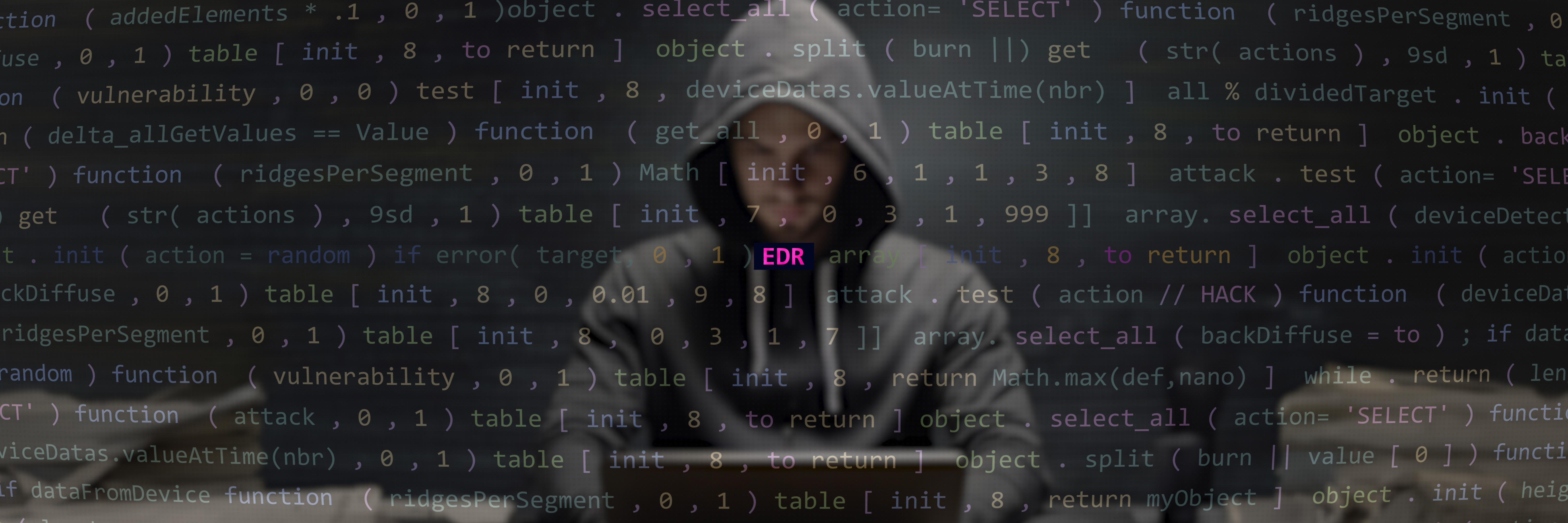
Traditional EDR tools operate as isolated agents, each generating its own telemetry, rules, and alerts. In real enterprise environments, this creates a detection surface defined by:
• Competing agents
• Redundant event streams
• Inconsistent behavioral context
• Delayed containment
• Unstable endpoint performance
SOC teams drown in duplicated alerts.IR teams struggle with incomplete visibility.
Endpoints degrade under the weight of overlapping tools.
AQUILA Endpoint Agent corrects this by embedding EDR into a single, unified endpoint architecture that consolidates nine security functions into one coherent platform.
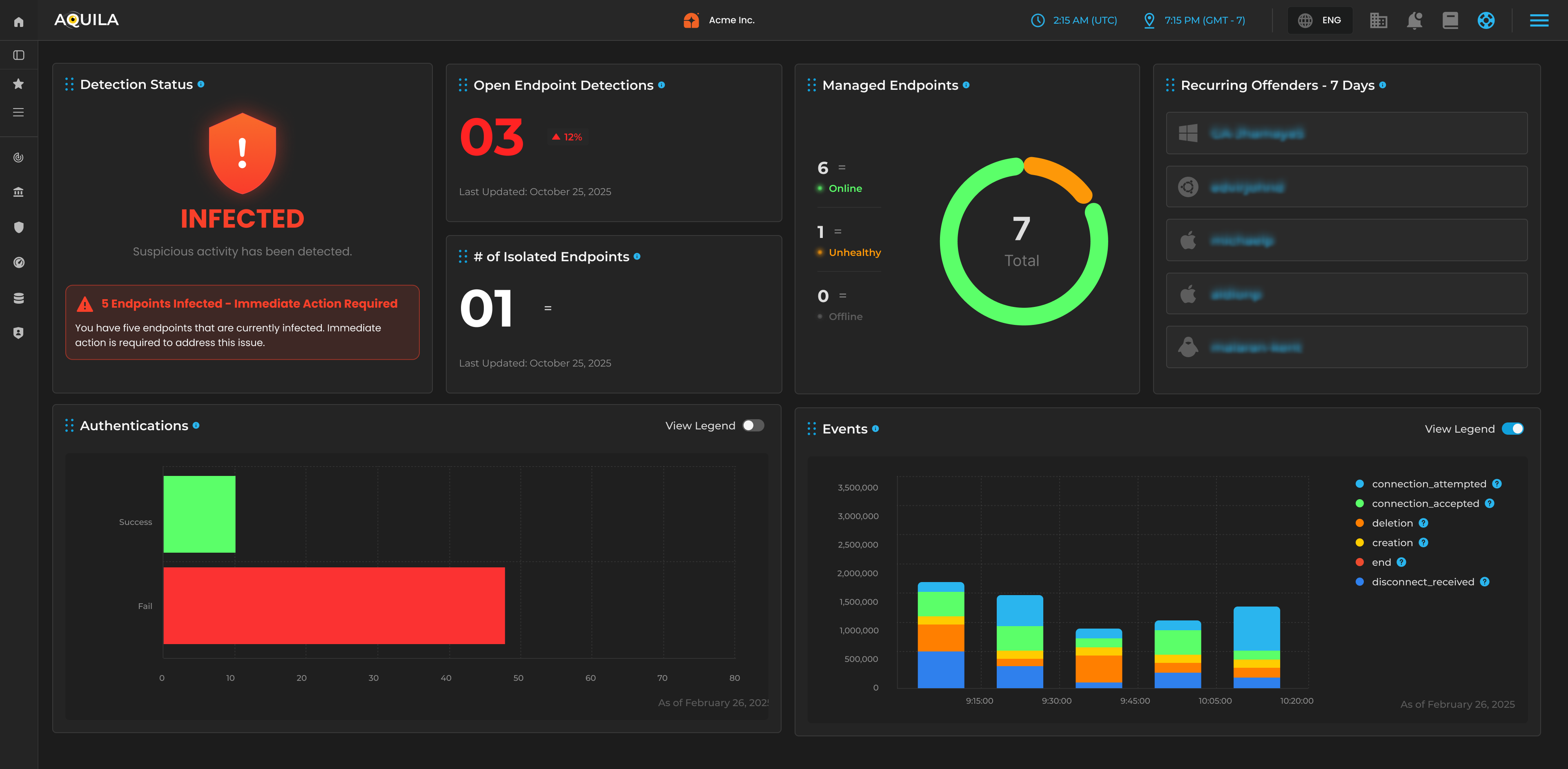
AQUILA’s EDR module is powered by Elastic Security’s endpoint engine, which provides:
• High‑fidelity telemetry ingestion
• Behavioral rule execution
• MITRE ATT&CK® mapping
• Malware detection and classification
• Kernel‑level event visibility
CyTech extends this foundation with:
• Enterprise‑grade orchestration
• Policy enforcement
• C4I‑aligned telemetry structuring
• Integration hooks for SOC workflows
• Unified endpoint governance
This combination produces an EDR capability that is technically rigorous, operationally coherent, and architecturally stable.
Elastic Security’s engine, the core of AQUILA’s EDR, has been validated through independent testing:
• VB100 certification with 98.26% malware detection across 2,127 samples.
• 0.001% false positive rate across 100,000 clean files.
• 100% protection in AV‑Comparatives’ Business Security Test.
• 100% detection of 1,018 recent malware samples.
These results confirm the engine’s reliability as a detection backbone.
AQUILA builds on this by embedding the engine into a unified endpoint architecture that eliminates agent sprawl and stabilizes performance.
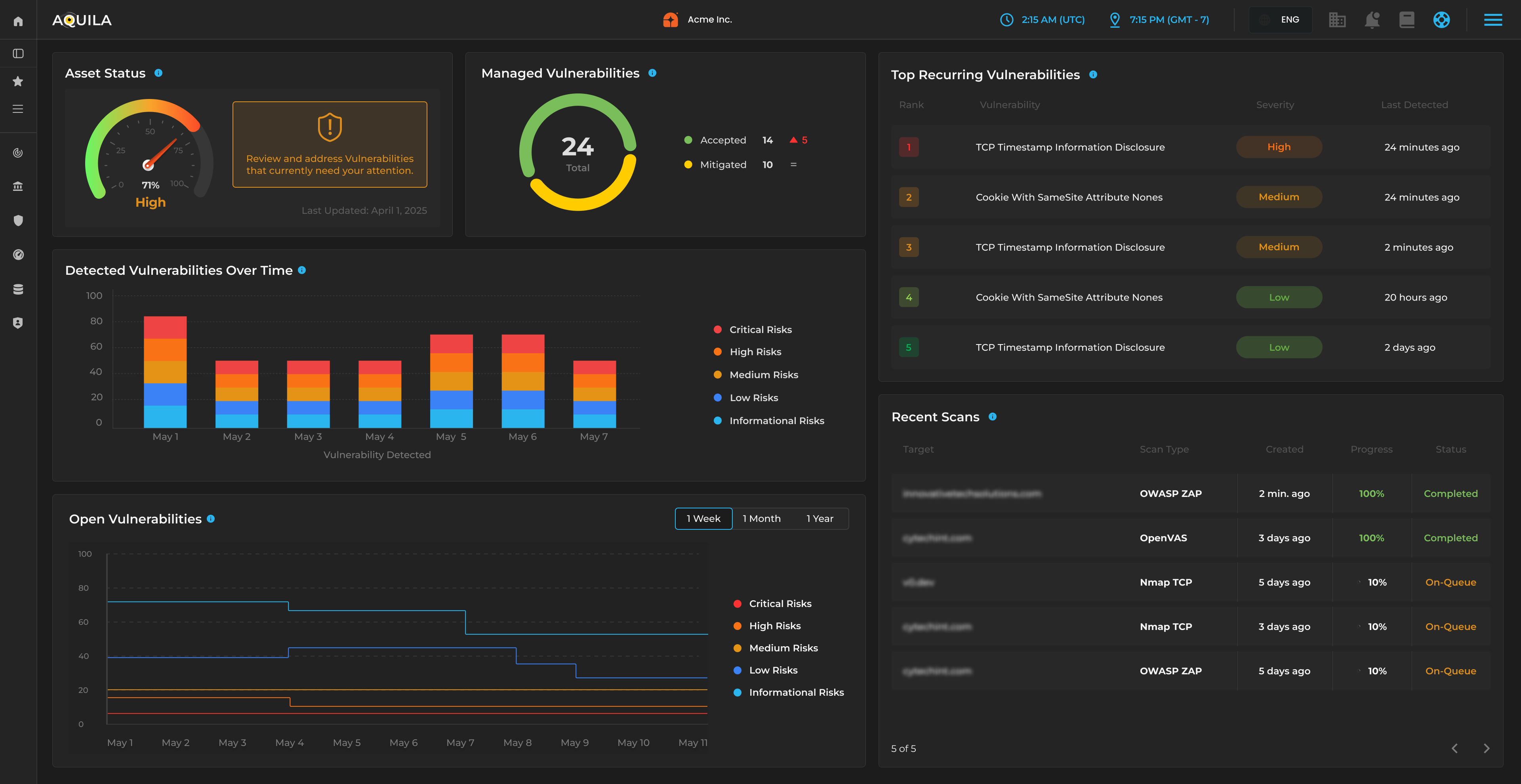
AQUILA Endpoint Agent applies the five C4I pillars directly at the device layer:
Command: Local enforcement of detection policies, governance rules, and response actions.
Control: Instant execution of containment actions — process termination, isolation, kill‑chain interruption — without waiting for external systems.
Communications: Structured, high‑fidelity telemetry streamed to AQUILA C4I Core OS for correlation across identity, cloud, data, and human‑layer signals.
Computers: Local analytics, behavioral baselining, and rule execution continue even when offline.
Intelligence: AI‑driven monitoring and UEBA models detect subtle behavioral deviations, staged attacks, and identity misuse.
This alignment ensures that detection is contextual, continuous, and operationally integrated.
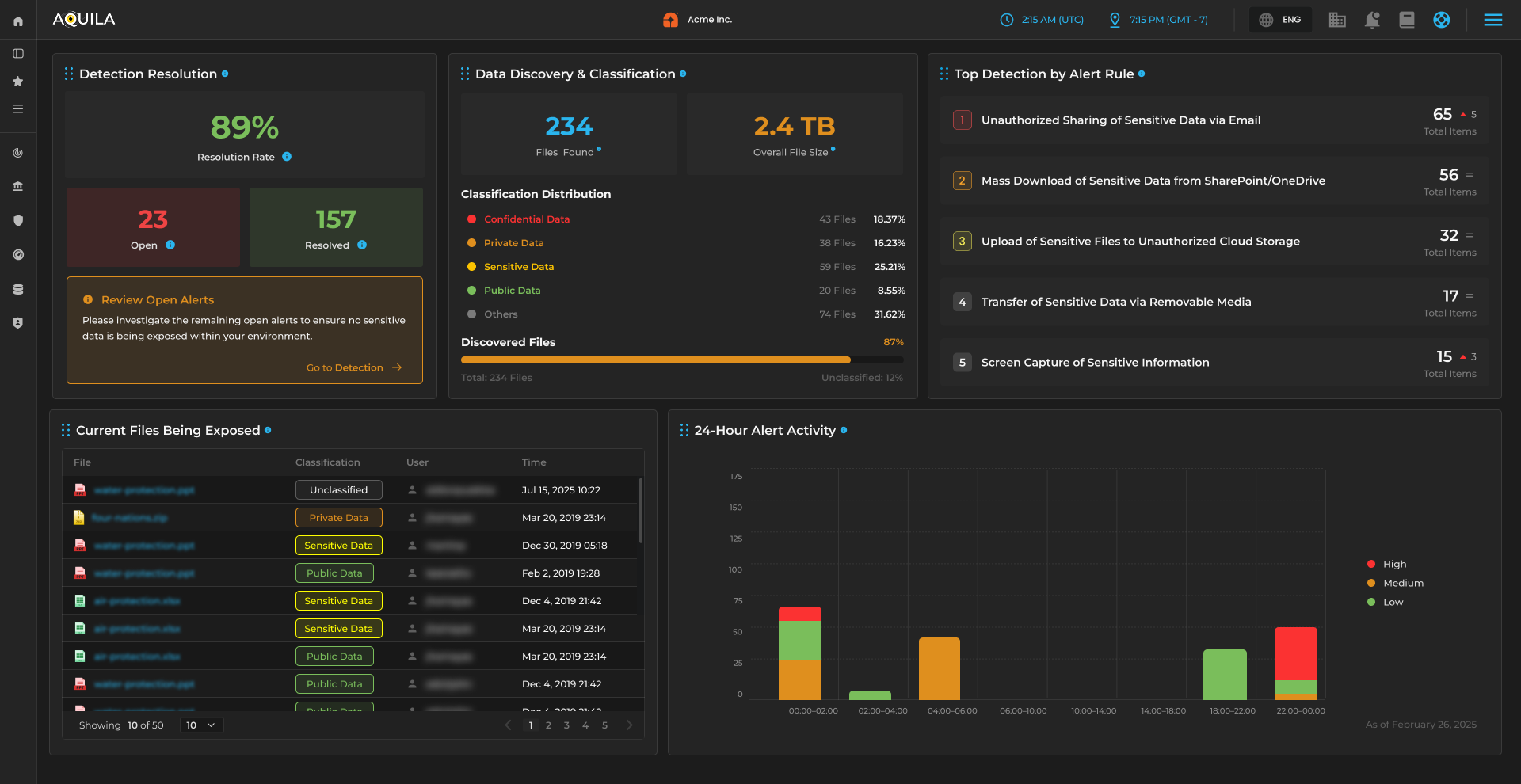
AQUILA EDR does not operate in isolation. It shares a common telemetry engine with: VDR, DLP, UEBA, AI‑driven monitoring, Local SOAR, Compliance enforcement, and Asset governance.
This eliminates:
• Duplicated events
• Conflicting signals
• Inconsistent baselines
• Multi‑agent interference
The result is a single, coherent event stream that SOC teams can trust.
AQUILA EDR continuously baselines:
Process behavior, file access patterns, network usage, identity activity, application behavior, and privilege escalation attempts.
This allows the system to detect:
• Lateral movement
• Credential misuse
• Staged exfiltration
• Dormant persistence
• Anomalous privilege elevation
• Suspicious parent‑child process chains
Because EDR is integrated with UEBA and AI‑driven monitoring, behavioral anomalies are evaluated in context — not as isolated events.
AQUILA’s EDR module includes local SOAR capabilities, enabling the agent to execute response actions instantly:
• Isolate the device
• Terminate malicious processes
• Block network connections
• Quarantine files
• Disable user sessions
• Enforce policy changes
These actions execute locally, without waiting for cloud‑based orchestration or external systems. This reduces detection‑to‑response time to near zero.
With AQUILA EDR, organizations gain:
1. Stable, high‑performance endpoints
No agent sprawl. No competing tools. No duplicated telemetry.
2. Unified detection across nine security functions
EDR is not a separate product — it is part of a coherent endpoint architecture.
3. Faster, more reliable incident response
Local SOAR actions execute instantly, even offline.
4. Contextual detection that reduces SOC fatigue
Behavioral analytics and AI‑driven monitoring filter noise and highlight meaningful signals.
5. A single source of truth for endpoint posture
All endpoint intelligence flows into AQUILA C4I Core OS.