
AQUILA Endpoint Agent integrates a host‑based DLP capability that enforces data handling policies in real time, communicates directly with centralized governance systems, and evaluates data movement in the context of identity, behavior, and operational risk.

![[interface] image of a computer showcasing educational software (for a edtech)](https://cdn.prod.website-files.com/6954708495d04649d41c9ddd/69adf253cdc09ce8b85da00b_DLP%201.jpeg)

Traditional DLP solutions operate as standalone agents or network appliances.
In practice, this creates:
• Inconsistent enforcement across devices
• Limited visibility into local file activity
• High false‑positive rates due to lack of behavioral context
• Fragmented policy engines
• Slow or manual remediation workflows
• User frustration and operational friction
Most DLP tools “see” data movement but lack the surrounding context — who the user is, what the endpoint is doing, whether the behavior is normal, and how it aligns with governance rules.
AQUILA Endpoint Agent corrects this by embedding DLP directly into the unified endpoint architecture, where identity, behavior, telemetry, and governance signals converge.
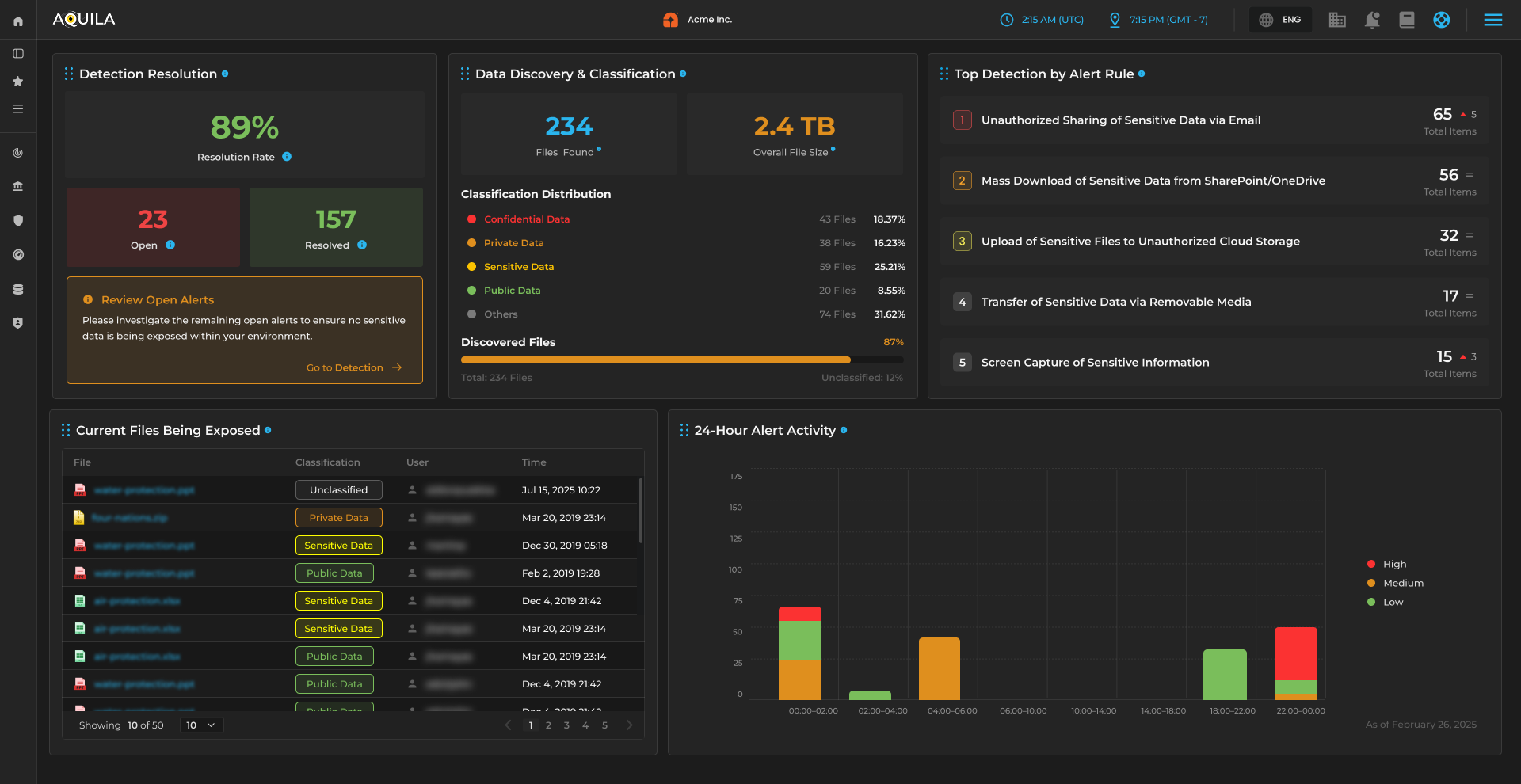
AQUILA’s DLP module is tightly integrated with CyTech’s Data Security Domain and operates as part of the endpoint’s unified security stack.
This enables the agent to:
• Monitor data in use, in motion, and at rest
• Enforce data handling policies in real time
• Evaluate actions based on user role, classification, and operational risk
• Apply adaptive controls based on behavioral and identity context
• Log events with forensic‑grade detail
• Synchronize decisions with AQUILA C4I Core OS
Unlike traditional DLP tools that operate in isolation, AQUILA’s DLP communicates directly with centralized governance systems, ensuring that enforcement is consistent, contextual, and aligned with enterprise policy.
AQUILA Endpoint Agent applies the C4I pillars directly to data protection:
Command: Local enforcement of data governance policies, classification rules, and handling requirements.
Control: Execution of adaptive controls — block, allow, quarantine, encrypt, or require justification — based on real‑time context.
Communications: Structured telemetry and policy decisions streamed to AQUILA C4I Core OS for enterprise‑wide visibility.
Computers: Local evaluation of file operations, clipboard activity, transfers, and application behavior — even offline
Intelligence: Integration with UEBA and AI‑driven monitoring to detect anomalous data access, suspicious transfers, or identity misuse.
This alignment ensures that DLP decisions are contextual, consistent, and operationally coherent across the entire endpoint fleet.
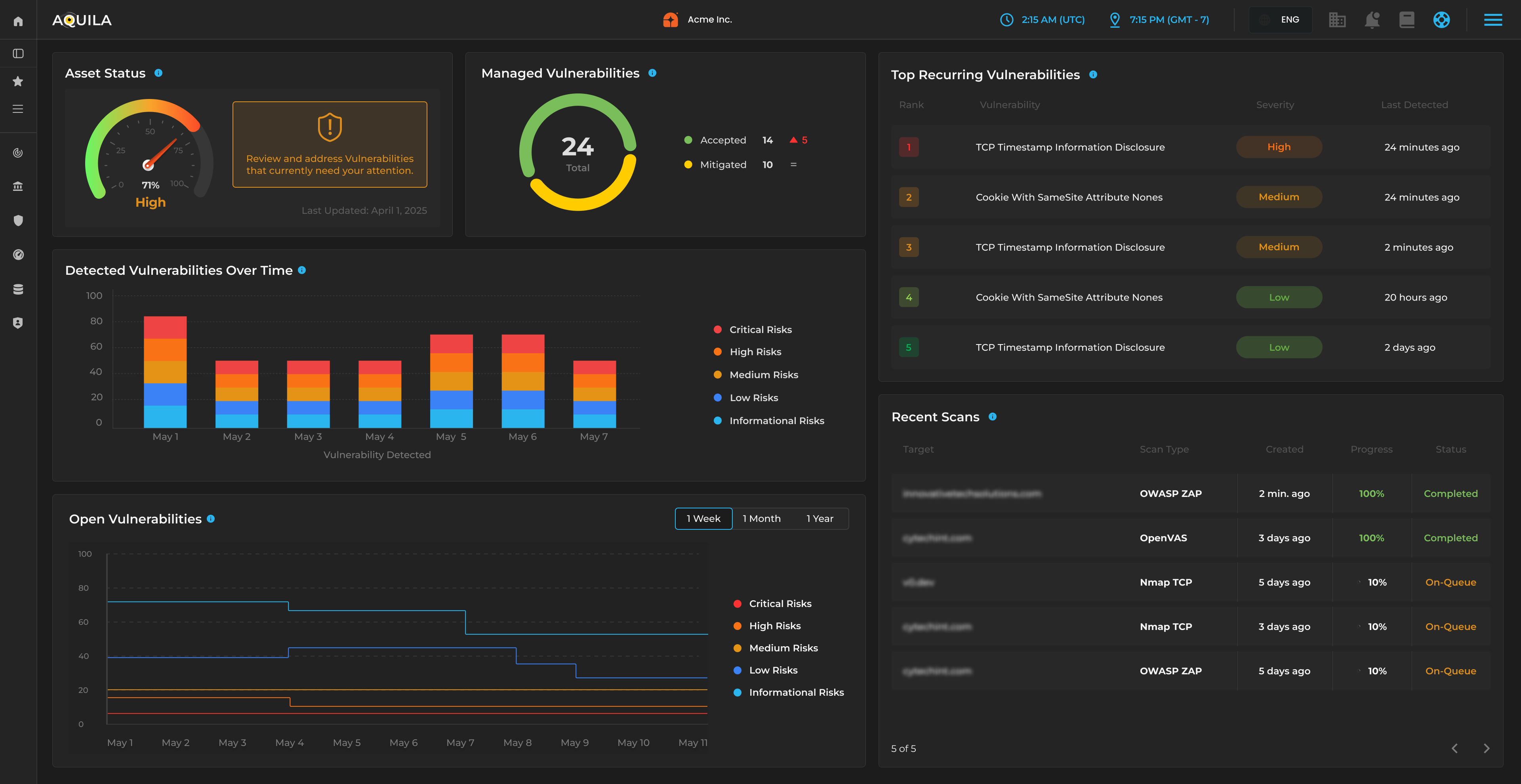
AQUILA DLP shares the same telemetry engine as EDR, VDR, UEBA, AI‑driven monitoring, Local SOAR, Compliance enforcement, and Asset governance.
This allows DLP to evaluate vulnerabilities in the context of:
• User identity and role
• Behavioral baselines
• Active processes
• Network activity
• Endpoint configuration
• Vulnerability state
• Compliance requirements
Traditional DLP tools cannot correlate data movement with this level of endpoint intelligence.
AQUILA DLP monitors:
File creation, modification, and deletion; Copy/paste operations; USB and removable media usage; Network transfers; Cloud sync activity; Application‑level data access; Clipboard interactions; and Sensitive file movement across directories.
When a policy violation occurs, the agent can:
• Block the action
• Require user justification
• Trigger adaptive prompts
• Log the event for forensic review
• Escalate to SOC workflows
• Execute automated SOAR actions
Because enforcement occurs locally, decisions are immediate and reliable — even when the device is offline.
AQUILA DLP is not limited to static rules. It leverages UEBA baselines, AI‑driven anomaly detection, identity‑aware context, endpoint posture signals, application behavior patterns.
This enables the system to detect:
• Unusual file access
• Abnormal data movement
• Suspicious privilege escalation
• Staged exfiltration
• Insider threat indicators
• Compromised identity behavior
DLP becomes part of a behavior‑aware protection model, not a standalone policy engine.
AQUILA DLP integrates with CyTech’s Data Security Domain, Unified Controls Blueprint (UCB), compliance enforcement modules, endpoint configuration governance, and identity and access signals.
This ensures that:
• Data handling aligns with regulatory requirements
• Evidence is collected automatically
• Policy enforcement is consistent across devices
• Compliance drift is detected in real time
DLP becomes a governance capability, not just a security control.
With AQUILA DLP, organizations gain:
1. Real‑time, endpoint‑native data protection
No reliance on network appliances or periodic scans.
2. Contextual enforcement that reduces false positives
Decisions incorporate identity, behavior, and system state.
3. Unified telemetry for data movement and risk
DLP becomes part of a coherent endpoint architecture.
4. Adaptive controls that balance security and usability
Users receive guidance, not just blocks.
5. A single source of truth for data governance
All data‑related events flow into AQUILA C4I Core OS.